

For calculating horse feed rations, consider your horse’s body weight alongside its daily needs. That’s a starting guide, not a set amount for every horse. Weighing hay and chaff gives you a clearer picture than estimating by the flake or scoop.
It’s easy to underestimate what goes into a feed bucket, especially when pasture, hay and additional feed all contribute to the daily ration. This guide explains how to estimate energy from forage and other feed, and how body weight, workload and condition affect the calculation. You’ll also learn what to record before adjusting your horse’s feed.
Key Takeaways
- Estimate the energy forage provides, then account for any additional feed to see how the full daily ration adds up.
- Use your horse’s weight and workload to guide its energy needs, rather than relying on a one-size-fits-all amount.
- Gather details such as body condition, current feed and activity level to make your ration calculation more useful.
- If additional feed is part of your plan, explore ADVANCE from Liken as one option.
Calories supplied by forage and additional feed
For Australian horse owners, ration planning starts with forage quality and the horse’s needs, not a one-size-fits-all amount of feed. Pasture composition varies by location and season, so base your estimate on what your horse is eating now.
Forage analysis and composition
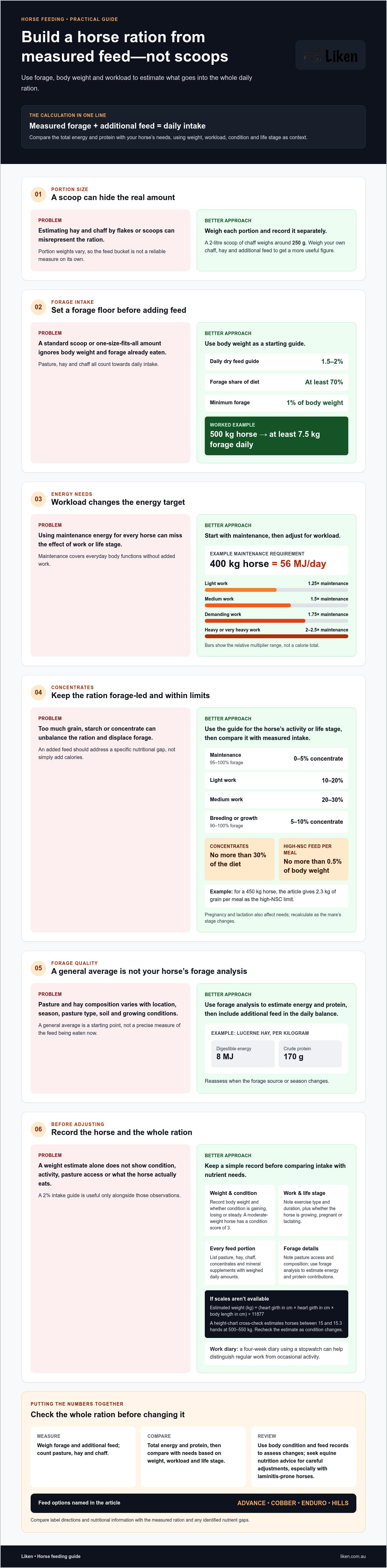
A forage analysis helps estimate the energy and protein supplied by hay or pasture. Use its digestible energy value to estimate calories, then include additional feed in the daily balance. For example, lucerne hay provides 8 MJ of digestible energy per kilogram and 170 g of crude protein per kilogram. These figures can help horse owners identify when forage already supplies substantial nutrients, or when the ration may need adjustment to avoid deficiencies.
Pasture and hay composition varies with location, pasture type, soil and growing conditions. Treat a general average as a starting point, not a precise measure of your own feed. For a more accurate calculation, use an analysis of the forage you’re feeding and reassess when the source or season changes.
Forage portions by body weight
Horses can generally consume about 1.5 to 2% of their body weight in dry feed each day. Forage should make up at least 70% of the diet, and horses should not be fed less than 1% of body weight in forage. A 500 kg horse should receive at least 7.5 kg of forage daily. Count pasture, hay and chaff as part of total intake.
Weigh portions rather than estimating by flakes or scoops, since their weights vary. A 2 litre scoop of chaff weighs around 250 g, but weighing your own portion gives a more useful figure. Use a kitchen scale for chaff, then record hay and additional feed separately. Compare their combined energy with the horse’s needs to keep the ration in balance.
Daily calorie requirements by horse weight and activity
Estimate energy needs based on body weight, then adjust for workload and life stage. Compare the target with measured intake, including forage.
Maintenance energy calculations
Maintenance is the energy an equine needs for everyday body functions without added work. One example gives a 400 kg horse a maintenance requirement of 56 MJ per day. Use the horse’s weight and the energy value of each feed to estimate whether the current ration meets that target.
Work changes the calculation: light work uses 1.25 times maintenance energy, medium work 1.5 times, and demanding work 1.75 times. Heavy or very heavy work can require two to 2.5 times maintenance energy. These multipliers help owners compare an individual horse’s needs with its nutritional intake.
Needs by activity and life stage
At maintenance, a ration chart lists 0-5% concentrate and 95-100% forage. For light work, it lists 10-20% concentrate; for medium work, 20-30%. Breeding or growth calls for 5-10% concentrate and 90-100% forage. Pregnancy and lactation also affect needs, so recalculate as the mare’s stage changes.
To compare requirements with intake, measure daily forage and additional feed, then total their energy and protein. A supplement should address a specific nutritional gap, not simply add calories. Consult an equine nutrition professional when the ration needs careful adjustment, particularly for a horse prone to laminitis.
Too much grain, starch or concentrate can unbalance the ration and displace forage. Keep concentrates to no more than 30% of the diet. High-NSC feed should not exceed 0.5% of body weight per meal; for a 450 kg horse, that is 2.3 kg of grain per meal.
Horse information needed for ration calculations
A useful ration estimate starts with the horse, not a standard scoop. Record body weight, condition, workload, life stage, pasture access and every feed portion before comparing intake with nutrient requirements.
Weight is the key starting measure. If scales aren’t available, estimate kilograms using this formula: heart girth in centimetres squared, multiplied by body length in centimetres, then divided by 11877. A height chart can provide a rough cross-check: horses between 15 and 15.3 hands are estimated at 500-550 kg. Recheck the estimate as condition changes.
Condition adds context to the number on the scales. A moderate-weight horse has a condition score of 3. Note whether your horse is gaining, losing or maintaining condition, then consider whether current forage and concentrate amounts suit that trend. A 2% intake guide is only useful alongside those observations.
Workload also affects the calculation. Record the horse’s actual exercise, including its type and duration. A four-week diary using a stopwatch can help distinguish regular work from occasional activity. Note whether the horse is growing, pregnant or lactating, too, as these life stages affect nutrient needs.
List pasture, hay, chaff, concentrates and mineral supplements, along with their weighed daily portions. A forage analysis helps identify energy and protein contributions, while pasture access and composition can vary. Compare these details with the horse’s weight, condition and workload before adjusting the ration. Keep your notes together to make future changes easier to assess.
With those details in hand, explore feed options to suit your horse’s feeding plan.
Liken: ADVANCE
Liken offers ADVANCE as one horse-feed option to consider after estimating your horse’s daily needs. Compare the feed’s label directions and nutritional information with your ration calculation, including forage, workload and body condition. Account for the whole ration rather than adding concentrate without considering what your horse already eats.
If you’re comparing options, Liken also offers COBBER, ENDURO and HILLS. Review each feed’s information against your horse’s measured intake and the nutrient gaps you’ve identified. A product should suit the horse and feeding plan, not replace accurate portion weighing or careful forage assessment.
Explore Liken’s horse-feed options online and choose what to consider for your ration.
Make your next feeding decision with confidence
Turn your ration estimate into a practical feeding plan by recording what you offer and how your horse responds. These notes provide a useful reference when pasture, workload or condition changes, helping you make purposeful adjustments. Keep feed label details with your records so you can compare each product’s nutritional information with the whole ration.
If you’re choosing an additional feed, Liken offers ADVANCE, COBBER and ENDURO. Compare their information with your horse’s needs as part of calculating horse feed rations, rather than choosing a feed in isolation. Explore the available options to see which may suit your feeding plan.
Contact Liken about your horse’s ration and take the next step with confidence.
Frequently Asked Questions
How do I know how much chaff or hay my horse is getting?
Weigh each portion instead of relying on a scoop or hay flake. Place an empty container on a kitchen scale, zero it, then add the chaff and record its weight. To weigh a hay net, weigh yourself holding the filled net, then subtract your weight alone. Use the same equipment each time so daily feeding records are comparable.
I got multiple diet suggestions, how do I know which one to choose?
Choose the suggestion based on the most accurate details about your horse and its current feed. Compare the assumptions, including estimated weight, condition, workload, pasture access and forage analysis. Check whether each plan counts all daily feed, including treats and supplements. If two plans differ, identify which input changed, as that often explains why their suggested amounts don’t match.
How do I calculate a horse's daily feed ration by body weight and workload?
Start with a reliable weight estimate and classify the horse’s workload, then total the measured forage and additional feed. For calculating horse feed rations, compare the energy supplied by those feeds with the horse’s estimated daily requirement. A 400 kg horse in maintenance has an example requirement of 56 MJ per day, while exercise increases the energy target.
What are Australian horses' daily energy, protein, fibre, vitamin and mineral requirements?
There isn’t one set daily target for every Australian horse; requirements vary with weight, workload, life stage and feed composition. As an example, a 400 kg maintenance horse’s listed protein requirement is 563 g daily. A sample calculator lists 20 g calcium, 14 g phosphorus, 15,000 IU vitamin A and 500 IU vitamin E. Use forage analysis to assess nutrients already supplied.
How much hay or pasture should a horse eat each day in Australia?
Use body weight and the forage’s dry matter to estimate intake, while accounting for pasture actually available and eaten. A 500 kg horse should receive at least 7.5 kg of forage daily. Pasture intake is harder to weigh directly, so monitor access and condition, and include hay or chaff in the overall forage amount rather than counting it separately.


