


More ingredients on the label don’t automatically make a hoof supplement the better choice. If product claims and nutrient amounts leave you unsure what your horse actually needs, this horse hoof supplement review will help you compare options more clearly.
It’s sensible to want stronger, healthier hooves, but a supplement needs to be considered as part of your horse’s full diet and care routine. This guide explains which ingredients and label details to compare, how to consider a product against your horse’s needs, and why visible changes take patience as new hoof grows. You’ll also learn what to monitor and when to seek advice from your vet or farrier. Use these steps to make a more informed choice and set realistic expectations.
Key Takeaways
- Use this horse hoof supplement review to compare what each label actually tells you, not just the ingredients featured on the front.
- Check how a supplement fits your horse’s complete diet before adding it to the feed routine.
- Keep hoof care and investigation of underlying issues in view. Supplements are only one part of supporting healthy hooves.
- Track hoof condition over time and keep expectations realistic, as visible changes take patience and results vary.
Horse hoof supplement reviews: what can a supplement realistically support?
A hoof supplement is a feed supplement intended to supply selected nutrients as part of a horse’s diet. It may be worth considering when you’re reviewing your horse’s nutritional intake, but it isn’t a shortcut to sound hoof care. Balanced feeding, regular farrier attention and a suitable living environment still matter. If hoof changes are sudden, persistent or accompanied by discomfort, seek veterinary advice to investigate possible underlying issues rather than relying on a supplement alone.
The hoof’s structure and function help explain why its condition can’t be reduced to one nutrient. Explore Horse Hoof Anatomy and Function for an overview of the parts involved. A horse hoof supplement review is most useful when it considers the horse’s wider needs, not just a product’s headline ingredient.
Dietary gaps may matter, but no single ingredient suits every horse. A nutrient can be relevant to hoof health without being the missing piece in every horse’s ration. The aim is to identify a genuine nutritional need, not to assume that adding more will automatically improve hoof quality.
When might a horse’s diet need a closer look?
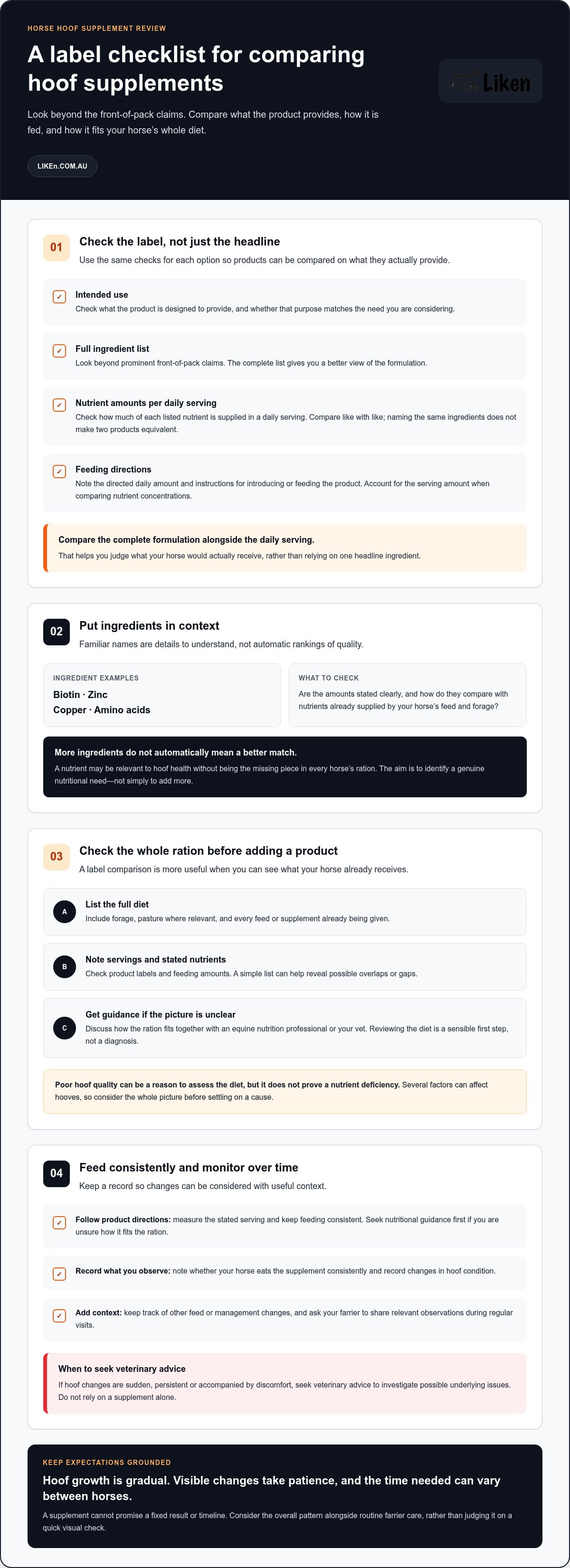
Poor hoof quality can be a reason to assess the diet, but it doesn’t prove a nutrient deficiency. Several factors can affect hooves, so look at the whole picture before settling on a cause.
Start with the full ration: forage, pasture where relevant, and every feed or supplement already being given. Check product labels and feeding amounts to see which nutrients are already supplied. A simple list of products, daily servings and stated nutrient amounts can help you spot possible overlaps or gaps. If you’re unsure how the ration fits together, discuss it with an equine nutrition professional or your vet. Reviewing the diet is a sensible first step, not a diagnosis.
How to review a horse hoof supplement label before buying
A clear label makes it easier to compare products beyond a familiar ingredient name. In this horse hoof supplement review, use the same checks for each option, then consider how it fits your horse’s existing ration.
- Check the intended use. Find out what the product is designed to provide and whether that purpose matches the need you’re considering.
- Read the full ingredient list. Look beyond prominent claims on the front of the pack. The complete list gives you a better view of the formulation.
- Find the nutrient amounts. Check how much of each listed nutrient is supplied in a daily serving. Compare like with like, rather than assuming two products are equivalent because they name the same ingredients.
- Review the feeding directions. Note the directed daily amount and any instructions for introducing or feeding the product. Don’t compare concentrations without accounting for the amount your horse is meant to receive.
Compare the complete formulation alongside the daily serving. This shows what the horse would actually receive and helps you avoid judging a product by one headline ingredient.
Which ingredients and label details deserve attention?
Biotin, zinc, copper and amino acids are terms you may see on hoof supplement labels. Treat them as details to understand, not automatic rankings of quality. Check whether amounts are stated clearly and compare them with nutrients already supplied by your horse’s feed and forage. A longer ingredient list doesn’t necessarily mean a better match.
Keep your notes on the full ration beside you as you compare labels. If you’re unsure how additives or nutrient amounts fit together, explore animal nutrition products online and use Liken’s technical expertise in additives and nutritional matching to support a considered decision.
Choosing and feeding a hoof supplement: make the review fit your horse
Turn your horse hoof supplement review into a practical plan before changing the feed routine. A simple decision path helps you make a considered choice and judge it fairly over time.
- Review the whole diet. Include forage, pasture and every feed or supplement your horse receives.
- Compare labels. Check the intended use, full formulation, daily nutrient amounts and feeding directions against your horse’s needs.
- Follow the product directions. Measure the stated serving and keep feeding consistent. If you’re unsure how it fits the ration, seek nutritional guidance before adding it.
- Track hoof condition. Keep notes so you can discuss changes with your farrier or vet, rather than relying on memory alone.
Keep expectations grounded. Hoof growth is gradual, and the time needed to see a change can vary between horses. A supplement can’t promise a fixed result or timeline. Consider the overall pattern alongside routine farrier care, rather than judging a product on a quick visual check.
What should you monitor after making a change?
Note whether your horse is eating the supplement consistently, record changes you observe in hoof condition, and ask your farrier to share relevant observations during regular visits. Keep track of other changes to feed or management too, so you have useful context. If concerns persist or you notice a sudden change, seek veterinary advice instead of relying on supplements alone.
When comparing feed and supplements, Liken’s technical expertise on additives and nutritional matching can help you consider how products fit into the wider diet. Explore Liken’s animal nutrition range as part of your research.
Take your next step with confidence
A thoughtful horse hoof supplement review can help you make a measured choice, but it’s still important to consider your horse’s overall nutrition. Use your diet notes and label comparisons to guide a conversation with your equine nutrition professional, vet or farrier, especially if hoof concerns continue or change suddenly. Give any feeding adjustment time, and keep observing rather than expecting an overnight difference.
Liken is an online retailer of animal feed and supplements, serving customers across Australia. Its technical expertise in additives and nutritional matching can help you explore nutrition choices with your horse’s wider diet in mind. Digital ordering, flexible delivery options and standing orders make it easier to manage regular animal feed and supplement purchases.
Explore Liken’s animal nutrition products and practical support to take your next step towards a well-considered feeding plan.
Frequently Asked Questions
Can biotin help improve a horse’s hooves?
Biotin may be relevant if it suits your horse’s nutritional needs, but its presence on a label doesn’t guarantee a benefit. In a horse hoof supplement review, compare the stated amount per daily serving and consider what the horse already receives from feed. If hoof problems persist, ask your vet or an equine nutrition professional whether diet or another cause needs attention.
How long does a horse hoof supplement take to show results?
There’s no reliable fixed timeframe, as hoof growth is gradual and changes vary between horses. Take a clear photo of each hoof when you start, then repeat from a similar angle during routine care. This can make gradual changes easier to compare than relying on memory. Keep feeding as directed, and discuss ongoing concerns with your farrier or vet.
Can I feed a hoof supplement with my horse’s regular feed?
A supplement can often be fed alongside regular feed if its directions suit the horse’s complete ration. Before combining products, note the serving size of each and check whether the same nutrients appear in both. Avoid increasing a serving to compensate for a perceived gap without professional guidance. For a specific dietary concern, speak with your vet or a qualified equine nutrition professional.
Are natural horse hoof supplements always better?
No. “Natural” alone doesn’t tell you whether a supplement is appropriate for your horse or how much of a nutrient each serving provides. Treat the term as a broad description, not proof of quality or suitability. Look for clear ingredient and feeding information, then judge the option by how it fits your horse’s needs rather than by a marketing claim.


